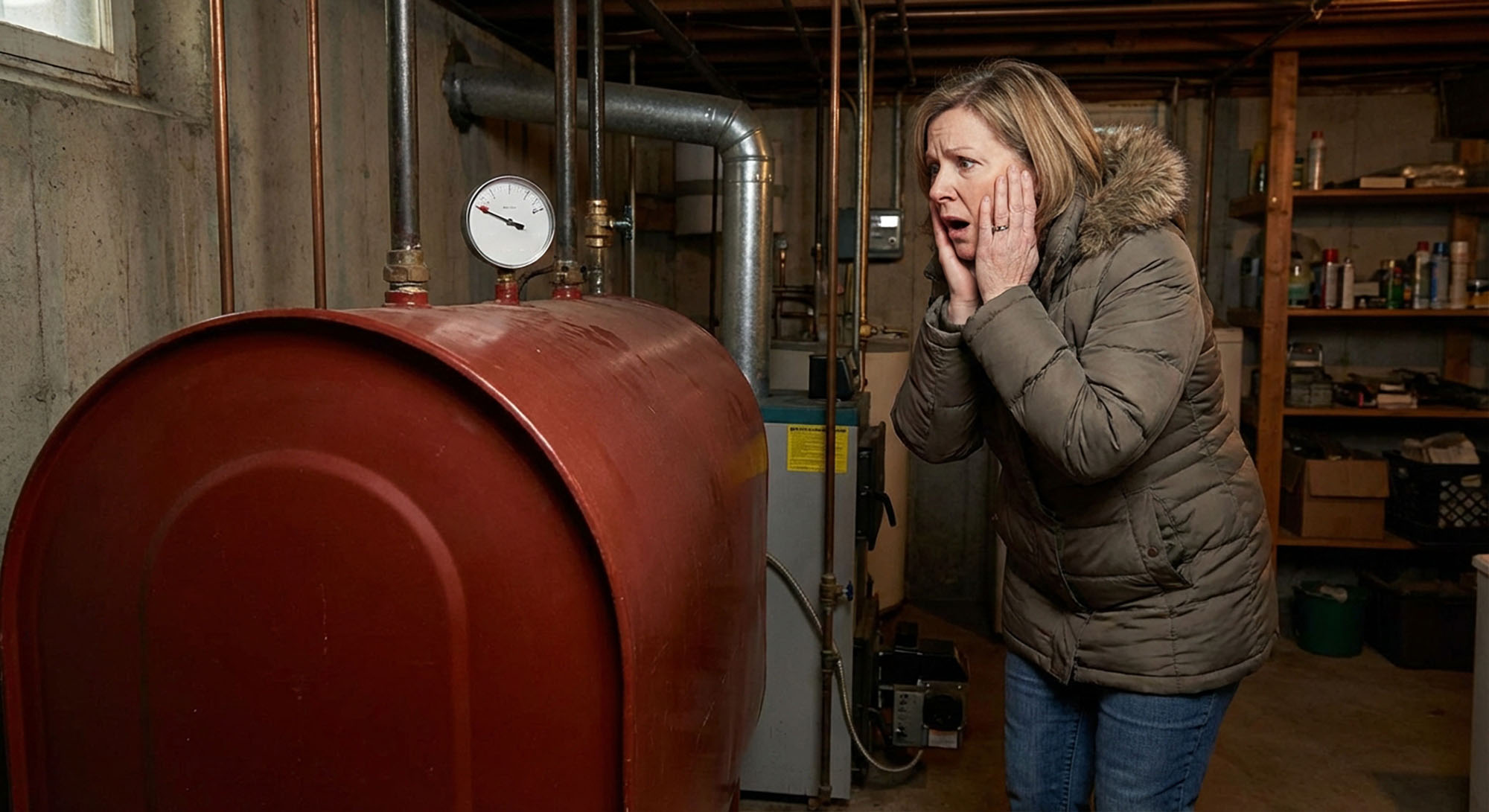
Your furnace just shut off and the tank gauge reads empty. Here's exactly what to do right now to get heat back in your house - from restarting your burner to finding emergency delivery.
Your house is cold. The furnace won't fire. You check the tank and the gauge is sitting on empty.
This is the moment most Rhode Islanders dread during heating season. You've run out of home heating oil, and you need heat back in your house right now.
Here's what happens next, step by step. No panic required.
What Happens When the Tank Runs Dry
When a heating oil tank empties completely, air gets into the fuel line between the tank and the burner. Your furnace needs a steady flow of liquid fuel to operate. Air breaks that flow.
The burner will try to fire, fail, and shut down. You might hear clicking or see the reset button pop. The system knows something is wrong.
Running a tank to empty also stirs up sediment that's been sitting at the bottom for years. That sludge can clog filters and nozzles if it gets pulled into the fuel line. This is why heating oil companies tell you to order before you hit a quarter tank.
But you're past that point now. So what do you do?
Step 1: Order Fuel Immediately
You need oil in that tank before you can restart the system. Call for delivery or order online right now.
If it's a weekday during business hours, you have options. Most heating oil dealers in Rhode Island can deliver same-day or next-day if you call early enough. Some offer emergency delivery for an extra fee.
The fastest way to compare prices and find dealers who can deliver today? Check RI Oil Prices. You'll see current pricing from 20+ dealers across the state, along with which ones offer emergency service. Look for the "Emergency Service" badge on dealer listings.
For example, if you're in Warwick, Cranston, or Providence, you can see which dealers serve your area and call them directly from the listing.
Order at least 100 gallons. Most dealers have minimum delivery requirements, and you want enough fuel to last a few weeks so you're not back in this situation next month.
Step 2: The Diesel Fuel Workaround (If You Can't Wait)
What if it's 10 PM on a Saturday and no dealer can deliver until Monday morning? You have a temporary option: diesel fuel.
Off-road diesel (the red-dyed kind used in construction equipment and farm machinery) is chemically similar to home heating oil. You can pour it directly into your heating oil tank as a short-term fix.
Drive to a gas station that sells diesel. Bring 5-gallon gas cans - you'll need at least two. Fill them with diesel fuel and pour the contents into your heating oil tank through the fill pipe.
Ten gallons of diesel will get your furnace running and keep your house warm for a day or two while you wait for a proper heating oil delivery. This is not a long-term solution. Diesel costs more per gallon than heating oil, and you're limited by how much you can transport in gas cans. But it works when you need heat tonight.
One warning: only use diesel fuel. Do not use kerosene, gasoline, or any other fuel. Those can damage your burner or create a fire hazard.
Step 3: Restart Your Furnace (The Right Way)
Once you have fuel in the tank - whether from a delivery truck or diesel cans - you need to restart the burner. This is where most people get stuck.
The problem is air in the fuel line. You need to bleed that air out before the burner will fire. Here's how to do it safely.
Turn off the power. Find the emergency shutoff switch for your furnace. It's usually a red switch on the wall near the unit or at the top of the basement stairs. Flip it to OFF. This is a safety step. You're about to work near the burner, and you don't want it trying to fire while your hands are on the fuel line.
Locate the bleeder valve. Look at the fuel pump on your burner. You'll see a small valve or screw, usually brass or silver, on the side of the pump. This is the bleeder valve. Some pumps have a small tube attached to the valve that drains into a container.
Get a container and a wrench. You'll need a small adjustable wrench or a 3/8-inch box wrench (depending on your valve type) and a shallow container to catch oil. An old coffee can or plastic takeout container works fine.
Open the bleeder valve slightly. Place the container under the valve. Use the wrench to turn the valve counterclockwise about one full turn. Don't remove it completely - just crack it open.
Turn the power back on. Go back to the emergency shutoff switch and flip it to ON. The fuel pump will start running. You'll hear it.
Watch for oil. Air and oil will start coming out of the bleeder valve into your container. At first you'll see sputtering and bubbles. Keep watching. After 30 seconds to a minute, the flow should become steady and bubble-free. That means the air is out of the line.
Close the valve. Once you see a steady stream of oil with no air bubbles, turn the bleeder valve clockwise to close it. Tighten it snug, but don't overtighten - you'll strip the threads.
Hit the reset button. Go to your burner and press the reset button. It's usually a red or black button on the burner control box. Press it once. The burner should fire up within a few seconds.
If the burner doesn't start, wait five minutes and press reset one more time. If it still doesn't fire after the second attempt, stop. Do not keep hitting the reset button. You could flood the combustion chamber with unburned oil, which creates a dangerous situation.
When to Call a Professional
If you've bled the fuel line and hit reset twice and the burner still won't start, call a heating technician. Something else is wrong.
Possible issues:
Clogged fuel filter (common after running a tank dry)
Clogged nozzle (from sediment)
Faulty ignition transformer
Tripped safety control
A technician can diagnose and fix these problems in one visit. Trying to troubleshoot further on your own risks damaging the burner or creating a safety hazard.
The same applies if you're not comfortable bleeding the fuel line yourself. There's no shame in calling for help. A service call costs $150 to $300 depending on the company and time of day, but it's worth it if you're unsure about any step in the process.
How to Avoid This Situation Again
Running out of heating oil is stressful and expensive. Emergency deliveries cost more. Service calls add up. And if you damage your burner by running it dry repeatedly, you're looking at a $500+ repair bill.
Here's how to make sure it doesn't happen again:
Check your tank gauge weekly. Make it a Sunday morning habit. Look at the gauge. If you're below half, start thinking about ordering. If you're at a quarter tank, order that week.
Sign up for automatic delivery. Many heating oil companies offer automatic delivery based on degree days and your historical usage. They calculate when you'll need a fill-up and schedule delivery before you run low. You never have to think about it.
Set up price alerts. If you prefer to order manually so you can shop around for the best price, set up a price alert on RI Oil Prices. You'll get an email when heating oil prices in your area drop below your target threshold. That way you can fill up when prices are low and avoid last-minute emergency orders when you have no negotiating power.
Keep a list of emergency contacts. Save the phone numbers for 2-3 heating oil dealers who offer 24/7 emergency service. When you need fuel at 11 PM on a holiday weekend, you don't want to be Googling "emergency heating oil delivery near me" while your pipes are freezing.
The Real Cost of Running Out
Beyond the immediate inconvenience, running your tank to empty costs you money in ways that aren't obvious.
Emergency delivery fees run $25 to $100 on top of the per-gallon price. You're also buying oil when you have zero leverage. The dealer knows you're desperate. You'll pay whatever they quote because you need heat tonight.
If sediment clogs your fuel filter or nozzle, that's a service call. If the technician has to replace the filter, nozzle, and clean the combustion chamber, you're looking at $200 to $400 in labor and parts.
And if you keep hitting the reset button trying to get the burner to fire, you risk flooding the combustion chamber with oil. That creates a puffback - a small explosion that sends soot throughout your basement and potentially your whole house. Cleaning up a puffback costs thousands of dollars.
The lesson? Order oil when you're at a quarter tank. It's cheaper and safer than waiting until the gauge reads empty.
What About Payment Plans?
If the reason you ran out of oil is cost - you couldn't afford a full delivery - talk to your heating oil dealer about payment plans or budget billing.
Many Rhode Island dealers offer budget billing programs where you pay a fixed monthly amount year-round based on your estimated annual usage. This spreads the cost out so you're not hit with a $600 bill in January when you need 200 gallons.
Some dealers also work with customers on payment plans for emergency deliveries. They'd rather get paid over 60 days than have you freeze or switch to a competitor.
There are also state and federal assistance programs for low-income households. The Rhode Island Energy Assistance Program provides grants to help pay heating bills during winter months. If you're struggling to afford heating oil, apply. The program exists for exactly this reason.
Bottom Line
Running out of home heating oil is fixable. Order fuel, bleed the air out of the fuel line, restart the burner. If you're not comfortable doing it yourself, call a technician.
The key is acting fast. The longer you wait, the colder your house gets and the higher the risk of frozen pipes.
And once you're back up and running? Set up a system so it doesn't happen again. Check your gauge weekly, sign up for automatic delivery, or set price alerts so you can order before you hit empty.
You can compare current heating oil prices across Rhode Island right now at RI Oil Prices. Find dealers in your town - whether that's Pawtucket, Woonsocket, Newport, or anywhere else in the state - and see who offers emergency delivery, next-day service, and the best oil prices in RI.
The next time your tank gauge drops below a quarter, you'll know exactly what to do.
About the Author
Chris Sommers
Chris is the youngest person ever inducted into the Home Heating Oil Hall of Fame and served as lead fuel analyst for three U.S. presidential administrations. A classically trained thermostat whisperer, Chris holds the Guinness World Record for fastest residential tank estimation (2.3 seconds) and once negotiated a ceasefire between feuding propane and heating oil lobbyists. Chris enjoys ice fishing and competitive caulking.